01
An introductory call
We go through your offer and your client as you understand them today. This is where we find out how much of the story already exists and how much of it people disagree about without knowing it.

Storybuilding Narrative Charter
This is where the story actually gets built. Your client-facing people, a series of two-hour workshops, and a story your team can use without me in the room.
From CHF 12’000.
Five to nine two-hour sessions. I keep going until you own it, and the number of sessions does not change the price.
Every month the story stays unbuilt is another month your team improvises it, differently, in every room.
Book a story conversation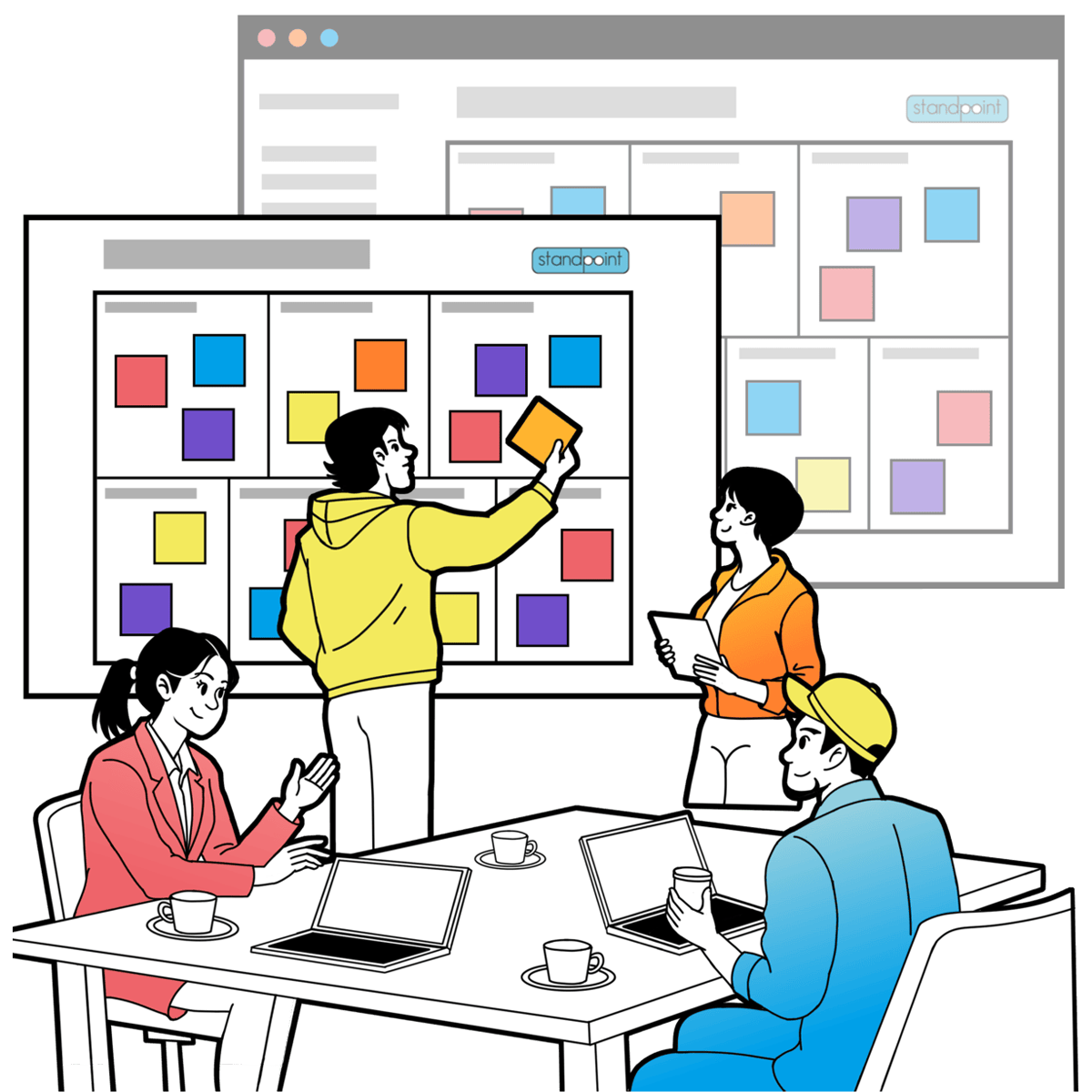
Nobody arrives here first. People arrive here having already run out of road somewhere else.
You had the Storybuilding Narrative Audit and its verdict was that the story itself is the ceiling — that no amount of retelling fixes what it is trying to say. This is what that verdict points at, and the full price of the Audit comes off it.
Your own people describe the company three different ways in one week and none of them is wrong. You do not need somebody to confirm that. You need the version they all end up using, and you need them to have built it.
Either way, the work is the same, and it starts with the people who do the talking.
The same shape every time, at a pace your team sets.
01
We go through your offer and your client as you understand them today. This is where we find out how much of the story already exists and how much of it people disagree about without knowing it.
02
We work online on Mural, a virtual whiteboard carrying the Storybuilding canvases and post-its. Everyone writes. Nothing depends on one person in the room having the best memory of what was said last time.
03
We work through the four canvases in turn — they are below. This covers several workshops, because the canvases argue with each other and that argument is the work.
04
Once there is a version worth showing, people take it back to real clients and prospects and try it on them. What comes back is evidence, not opinion, and it is what the next sessions are spent on.
05
We keep sharpening. At some point we take a break from the model and play with the tagline — not a catchy line, but the story compressed to something that survives being repeated.
06
Not when a deliverable is handed over. When your team is happy with the story, uses it without checking, and would defend it to someone who pushed back.
Your team fills them in together on Mural, one after the other. The first two are the deep dive — your customer, then your company. The last two build the story on the three steps your customer takes: Recognition, Perception, Projection.
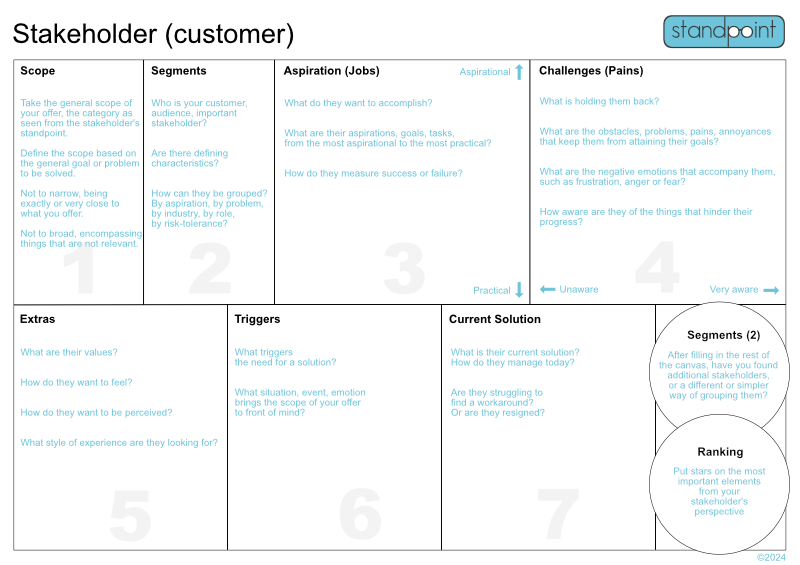
01 Stakeholder
Who you are addressing, what they aspire to, what holds them back, how they manage today, and what triggers the need for change.
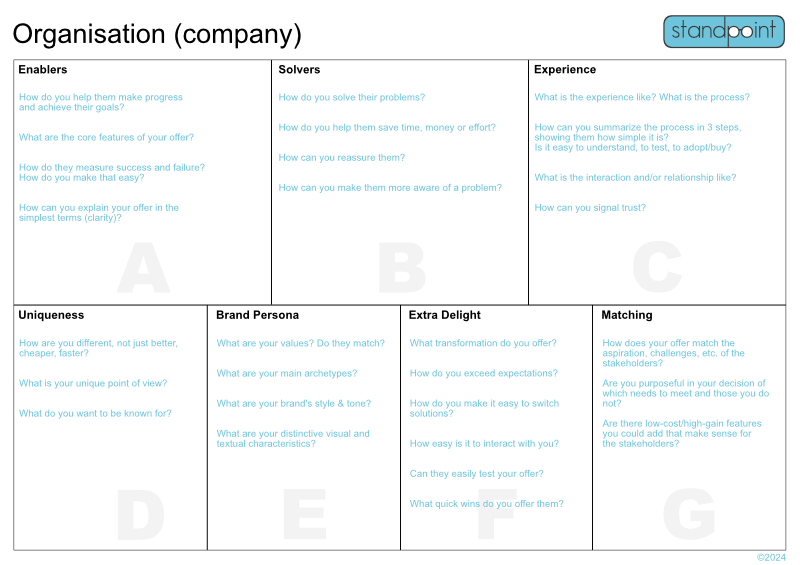
02 Organisation
How your customers see you: how you enable their success, the experience you offer, the category you want to be seen in, and what makes you different.
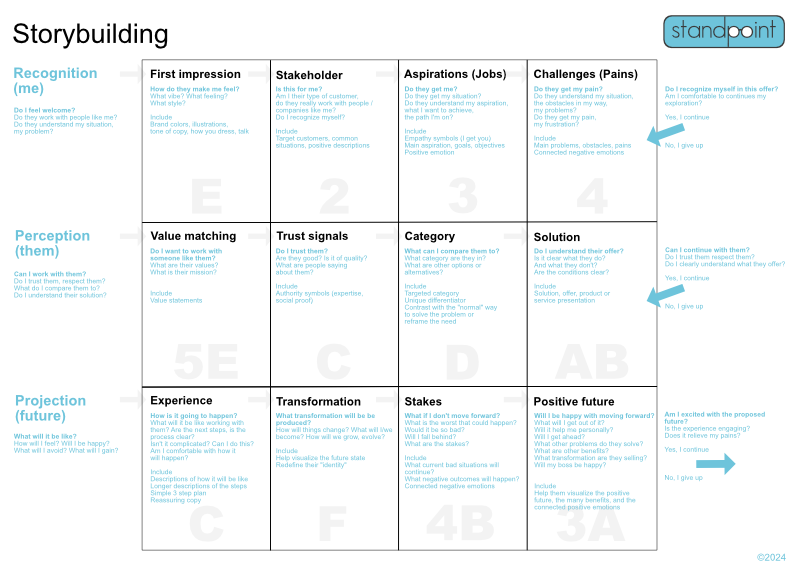
03 Storybuilding
The three steps of consideration, and the emotional ups and downs that carry your audience through them to the action you want.
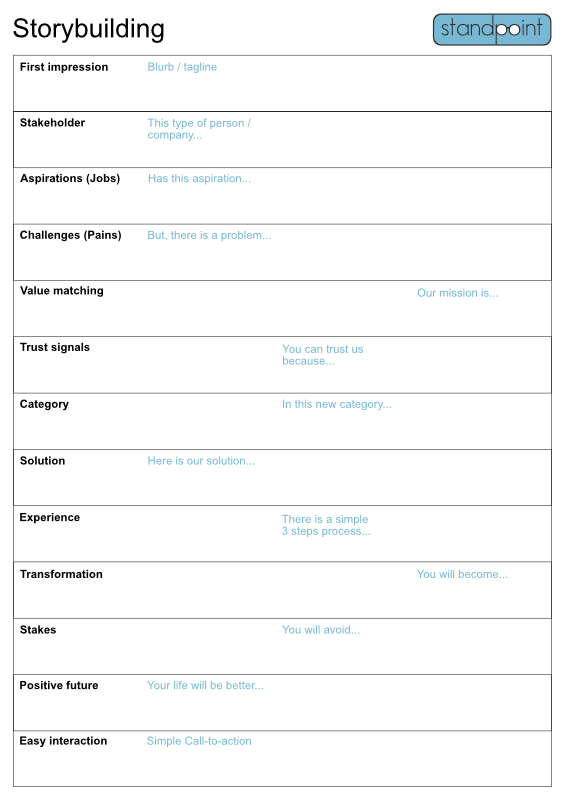
04 Story
The same three steps, this time in words: who it is for and what it recognises in them, the standpoint you take and the category you claim, the change you promise and the proof that makes it believable.
The team is your front, client-facing people: marketing, sales, and the CEO or founder, depending on the size of the company and how it is structured. The people who meet clients are the people who have to own what they say — so they are the people who build it.
How many of them there are does not change what the Charter costs.
Between five and nine two-hour sessions, so at least a dozen hours of work together. I deliberately do not cap it: the commitment is that I work until you have your story and are happy with it.
What makes one Charter longer than another is not the size of the company. It is how complex the story is and how far the team wants to take it — some are satisfied with an early version, others keep refining.
The longest Charter I have run. That company's story is written up as a case study —read what changed.
How long it takes and how much it costs are two different questions here. The first varies. The second does not.
The Charter is two things: the story, and the rules that keep it true. Both are built with your team, in the room, and both stay with you.
The sentence, the thirty seconds, the paragraph, the tagline direction — written down, in a form your team can use without me. Everything you make afterwards is an adaptation of that one story: a website, a campaign, an investment pitch. Different situations, different lengths, the same story underneath. That is what makes them agree with each other.
And the rules that keep it true
A written test anyone can apply to a draft before it ships: does this open from the customer’s standpoint, does it say what only you can say, does it match the story we agreed. Not taste. A rubric two people apply the same way.
The specific moments where the rubric is applied — which drafts, at which stage, by whom. Put in the places where things actually get approved, not added as a stage nobody has time for.
Who can say no, and who can overrule that no. Most drift is not carelessness — it is an unresolved argument shipping as a compromise, because nobody was named as the person who decides.
From CHF 12’000
Everything needed to get one team to one story it owns.
Three things, all of them things you choose to add rather than things we discover once we have started.
And if it does not work, you do not pay. That is not a figure of speech —it is written down.
Not yet sure the story needs rebuilding at all? That is what the Storybuilding Narrative Audit is for — CHF 2’500, and credited in full against the Charter if it sends you here.
Tell me where your story stops working. No pitch. No obligation.